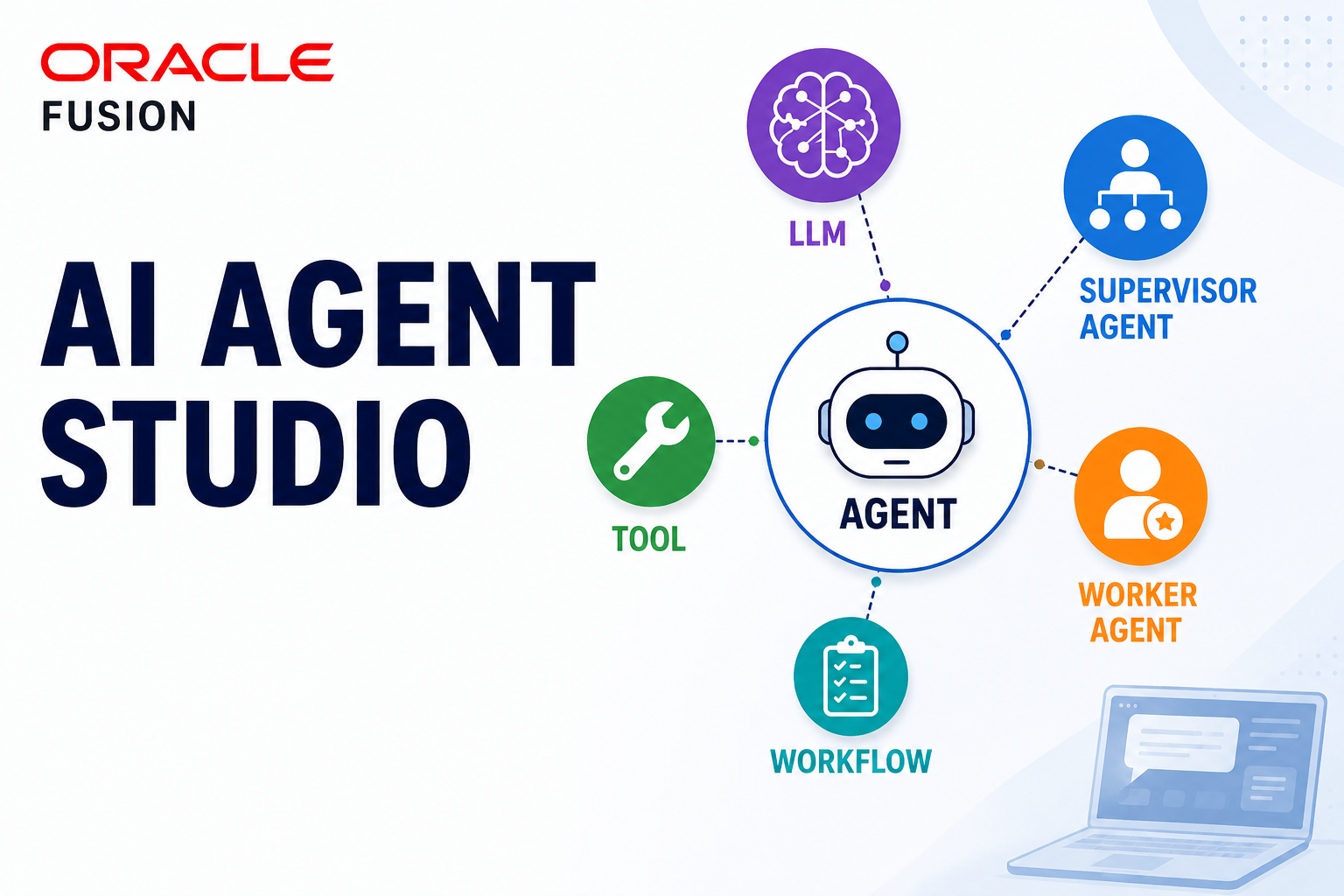
Oracle Fusion AI Agent Studio: Key Terms, Simply Explained
If you’ve started exploring Oracle Fusion AI Agent Studio, you’ve probably run into a wall of new terminology — Agent, LLM, Tool, Supervisor Agent, Worker Agent, Workflow. Each term sounds simple on its own, but together they describe a small ecosystem, and it’s easy to lose track of how the pieces fit together.
This post walks through each concept in order, building up from the most fundamental building block (the Agent) to the full picture of how a request actually gets handled end-to-end.
1. Agent — The Assistant That Takes Action
At the center of Agent Studio is the Agent itself. An Agent is a smart assistant embedded inside Oracle Fusion that understands what a user is asking for and takes action on their behalf — instead of the user manually clicking through multiple screens, forms, and menus to get something done.
Think of the Agent as the front door to the whole system. A user types a request in plain language — “show me overdue invoices for vendor ABC” — and the Agent is responsible for understanding that request and making sure it gets fulfilled.
On its own, though, an Agent isn’t magic. It needs two things to actually function: a way to understand and reason about language, and a way to carry out real actions. That’s where the LLM and Tools come in.
2. LLM (Large Language Model) — The Brain Behind the Agent
The LLM is the reasoning engine that powers the Agent. It’s the underlying AI model that reads and understands natural language, works out what the user actually means, and decides what needs to happen next to fulfill the request.
Where the Agent is the visible assistant a user interacts with, the LLM is the invisible intelligence running behind the scenes. It doesn’t directly touch Oracle Fusion data or systems — instead, it interprets intent and plans the steps required.
- Understands language: Interprets what the user is asking, even if it’s phrased casually or ambiguously
- Reasons through requests: Breaks a request down into the steps needed to satisfy it
- Decides next actions: Chooses which Tool, or which Worker Agent, should handle each step
Without an LLM, an Agent would just be a static form. The LLM is what makes the interaction feel conversational and intelligent rather than scripted.
3. Tool — How the Agent Gets Things Done
Understanding a request is only half the job — the Agent also needs a way to actually do something about it. That’s the role of a Tool. A Tool is how the Agent reaches out into the real world: an API call, a database query, or any other concrete action that produces a real result inside Oracle Fusion.
If the LLM is the brain deciding what should happen, the Tool is what actually makes it happen. Tools are what connect reasoning to execution.
- API call: A REST or SOAP call to a Fusion service
- Database query: A SQL query against Fusion tables or views to fetch specific records
- Real action: Creating, updating, or submitting something inside Fusion on the user’s behalf
Every meaningful outcome an Agent delivers — a report, a submitted transaction, a status update — ultimately traces back to one or more Tools being invoked.
4. Supervisor Agent — The Coordinator
As Agent Studio implementations grow, a single Agent handling every possible request becomes unwieldy. This is where the Supervisor Agent comes in. The Supervisor Agent acts as the manager of a team of Agents — it decides which Worker Agent should handle a given task and coordinates the handoff between them.
Rather than trying to be an expert in everything, the Supervisor Agent’s job is triage and coordination: understand the broad category of the request, and route it to the specialist best equipped to handle it.
- Entry point: Receives the incoming request first
- Routing logic: Uses reasoning (via its own LLM) to identify the right Worker Agent for the job
- Handoff: Passes the request — and any needed context — to that Worker Agent to execute
This coordinator pattern keeps individual Worker Agents narrow and reliable, while still giving users a single, unified point of interaction.
5. Worker Agent — The Specialist
A Worker Agent is a specialist built to do one job well. Rather than being broad and general-purpose, a Worker Agent is scoped tightly — focused, accurate, and good at exactly one thing, such as retrieving invoices, checking payment status, or validating purchase orders.
This specialization is deliberate. A narrowly scoped Worker Agent is easier to build, test, and trust than one large Agent that tries to do everything. Each Worker Agent is typically paired with a small, specific set of Tools relevant to its one job.
- Example — Invoice Worker Agent: Retrieves invoice details and payment status for a given vendor
- Example — PO Worker Agent: Checks approval status and routes purchase orders for review
- Why narrow scope matters: Because its scope is narrow, it’s less likely to misinterpret a request or take the wrong action
Multiple Worker Agents can exist side by side under a single Supervisor Agent, together covering a wide range of functional areas while each one stays simple and dependable on its own.
6. Workflow — The Recipe That Ties It All Together
The Workflow is the step-by-step recipe that connects everything above into a coherent process. It defines the order of operations: first do this, then this, check this, then done.
A Workflow is what ensures a request doesn’t just get “understood” — it gets carried through to a correct, verified outcome, potentially involving several Tools, checks, or even multiple Worker Agents along the way.
- Step 1: Retrieve the invoice record
- Step 2: Validate the vendor and amount against source data
- Step 3: Confirm status and return a formatted result to the user
Workflows bring predictability and repeatability to what would otherwise be ad-hoc reasoning — the same type of request follows the same reliable path every time it’s handled.
Putting It All Together
Here’s the full picture, from first principles to the finished process:
| Term | What It Does |
|---|---|
| Agent | Understands the user’s request and takes action |
| LLM | The brain — reasons through the request and decides what’s needed |
| Tool | The hands — how the work actually gets done (API, query, action) |
| Supervisor Agent | The coordinator — routes the task to the right specialist |
| Worker Agent | The specialist — focused, accurate, does one job well |
| Workflow | The steps — the recipe that ties everything together in order |
Once these six pieces click into place, Agent Studio stops feeling like a wall of jargon and starts feeling like what it actually is: a small, well-organized team — a brain that reasons, hands that execute, a manager that routes, specialists that deliver, and a recipe that keeps it all consistent.
Back to All Blogs